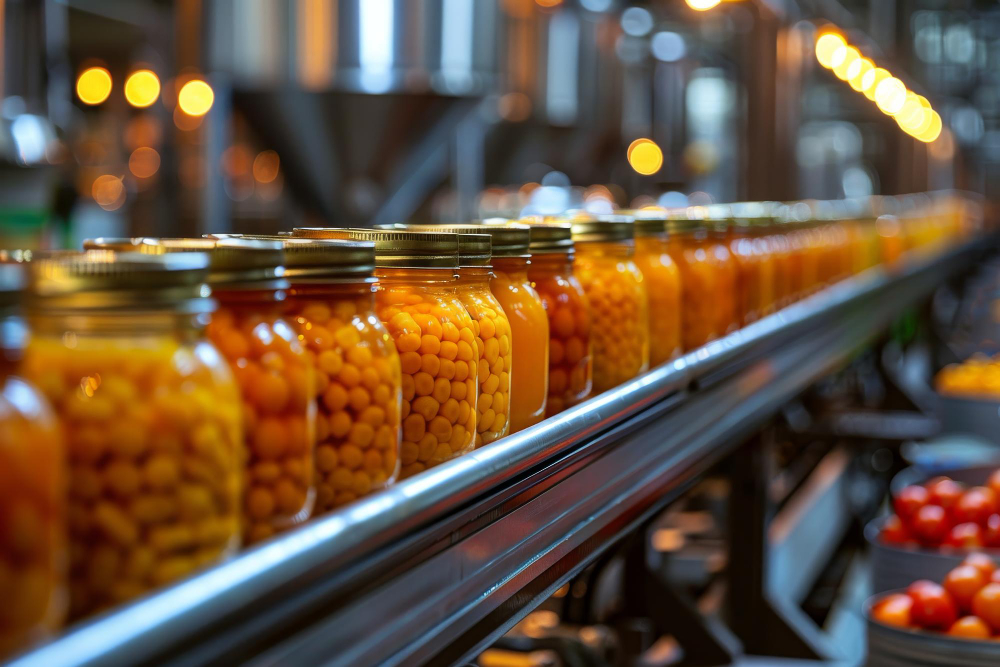
Jar inspection systems check every jar at the points where a jar line can fail: the empty container, the fill level, the cap and its seal, the label and the packed case. At E2M COUTH, we cover each of these stages with machine vision, rejection and end-of-line equipment, from the moment an empty jar enters the line until it leaves on a pallet.
This article is written for Production and Quality managers in food, cosmetics and chemical plants that pack in glass or plastic jars: preserves, jams, sauces, creams and similar products. We follow the jar through the complete line and explain which jar inspection machine vision system, rejection function or end-of-line machine works at each phase, and why the jar format needs a different approach from the one we described for glass bottles and cans.
Why jar inspection systems need their own approach
A jar is not a bottle with a wider neck. The wide mouth, the closure and the material change what has to be inspected and how the container has to be handled.
- Wide-mouth glass: The finish of a jar is large and exposed, so chips, cracks and dirt on the rim or inside the container are easier to miss and harder to clean out once product is added.
- Closure: Most food jars are closed with a metal twist-off or lug cap, and many products are packed under vacuum. A cap can look correct and still be crooked, loose or without the vacuum the product needs. Cosmetic and chemical jars often use plastic screw caps with their own fit and presence checks.
- Handling: Glass jars are heavy and fragile, while plastic jars are light and less stable. Both affect how a non-conforming unit is removed and how jars are grouped at the end of the line.
In our view, the capping station is where a jar line needs the most control, because a closure defect affects shelf life and food safety as well as appearance. That is why we recommend combining visual cap inspection with a vacuum check on vacuum-packed products instead of relying on one method.
Jar defect detection before filling
Jar defect detection starts with the empty container. Rejecting a cracked or dirty jar before filling avoids using product, caps and labels on a unit that would be rejected later, which reduces the cost of poor quality at the very start of the line.
Inspecting empty glass and plastic jars with Ebivision
Our Ebivision system uses machine vision to inspect empty containers for cracks, stains, foreign bodies and other defects on the walls and bottom. It also checks internal cleanliness, so the jar reaches the filler free of residues or particles.
Ebivision runs on VisioInspect 2.0, our in-house software with Deep Learning, which helps the system separate real defects from acceptable variations in the container. If your concern is contamination inside the filled product, our article on foreign body detection covers that stage in detail.
Jar orientation functions before filling, capping and labeling
Some jar lines need every container to reach the next machine in a defined position, for example when the jar has an embossed logo, a non-round shape or a label that must face a specific side. Orientation functions prepare the jar for filling, capping and labeling.
Positioning jars with Flexiturn
Flexiturn is our container orientation system. It uses machine vision to detect, identify and rotate each container based on visible features such as shapes, labels, engravings or marks, so it arrives correctly positioned at the following stations.
For glass jars, the relevant points are gentle handling of the container, quick format and product changes, and installation on the existing conveyor. The result is a constant flow of oriented jars, with less variability before the inspection points downstream.
Fill level inspection on clear and opaque jars
Fill level inspection confirms that each jar holds the right amount of product, with no underfill that affects net content and no overfill that interferes with the closure. When we plan fill level inspection, jars in clear glass and jars in opaque plastic call for different technologies.
Visiolevel for clear and translucent jars
Visiolevel is our machine vision fill level system. It detects overfilled and underfilled containers without contact with the product, adjusts automatically to containers of different heights and includes an algorithm that compensates for fluctuations in the liquid. It can also detect cap defects in the same inspection point.
InspectLevel RF for opaque jars
When the jar does not allow a camera to see the product, InspectLevel RF measures the fill level with radio frequency. It works on glass and plastic containers and can be combined with other E2M COUTH equipment to check cap and label presence. For the same stage on beverage lines, see our post on fill level and cap inspection on bottles.
Cap inspection and lid seal inspection after capping
Cap inspection and lid seal inspection verify that the jar is closed correctly before it moves on. On a jar line, this is the stage where we place the densest control.
Checking caps and metal lids with Visiocap and Contourcap
Visiocap checks cap presence, cap position and fit, measuring the distance between the ring and the cap to detect loose or crooked closures. It also detects deformations in the tamper-evident closure, cracked caps and incomplete caps, and works with plastic and metal caps. It can be installed on an existing conveyor or in the filler.
For a full view of the closure, Contourcap performs 360° cap inspection. It verifies that the cap is aligned and applied, that it is the correct type for the container, and that there are no broken bridges, surface defects or tamper-evident defects. Both systems offer real-time inspection data, MES or ERP connectivity and a low level of false rejects, which protects OEE as well as quality.
Vacuum control with Inspectvacuum
A metal lid can be seated correctly and still lack vacuum. Inspectvacuum detects irregularities in the vacuum of each container and installs on the existing belt, on low-, medium- or high-speed lines. Combining visual lid seal inspection with vacuum control gives the Quality team two independent signals on the same closure.
Label and code verification on jars
Once the jar is closed, the label and the batch code are the information that follows the product to the customer. Errors at this stage do not affect the product inside, but they can lead to returns, reprocessing or a recall.
Contourvision and Verifytext
Contourvision is our 360° label inspection system. It checks label orientation, alignment and position, and detects wrinkles, breaks, raised tips, stains and double labeling. It also reads 1D and 2D codes and verifies colors, graphics and text. Verifytext inspects printed text and codes on all units without handling the product, so lot numbers and dates can be checked at line speed.
Choosing a reject system for jars
A reject system for jars must remove the non-conforming unit without breaking glass, tipping the next jar or stopping the line. Detecting a defect only reduces the cost of poor quality if the right unit leaves the flow at the right point.
Multistep, Proportional Rejection and Push Rejection
When a vision system flags a jar, the signal is sent to the rejection system, which tracks the unit and removes it at the defined point. At E2M COUTH, we select the rejection function according to the jar’s stability, weight and the line layout:
- Multistep: Stable and gentle rejection or deviation, designed to avoid damaging the removed product so it can be analyzed later. A sensible choice for heavy glass jars.
- Proportional Rejection: Displacement rejection that keeps containers stable during the movement and can send them to a specific area or to an adjoining conveyor for reprocessing.
- Push Rejection: Impact rejection for single-lane lines, suited to stable containers.
All three are compatible with inspection systems from other manufacturers, so a new reject point can be added to the existing line.
Position matters as much as the mechanism. We usually recommend one reject point after the empty jar inspection and another after capping and labeling, so that a defective empty container never receives product and a badly closed jar never reaches the case packer. Rejection data by defect type also shows which station is generating the most non-conforming units.
Case packing jars at the end of the line
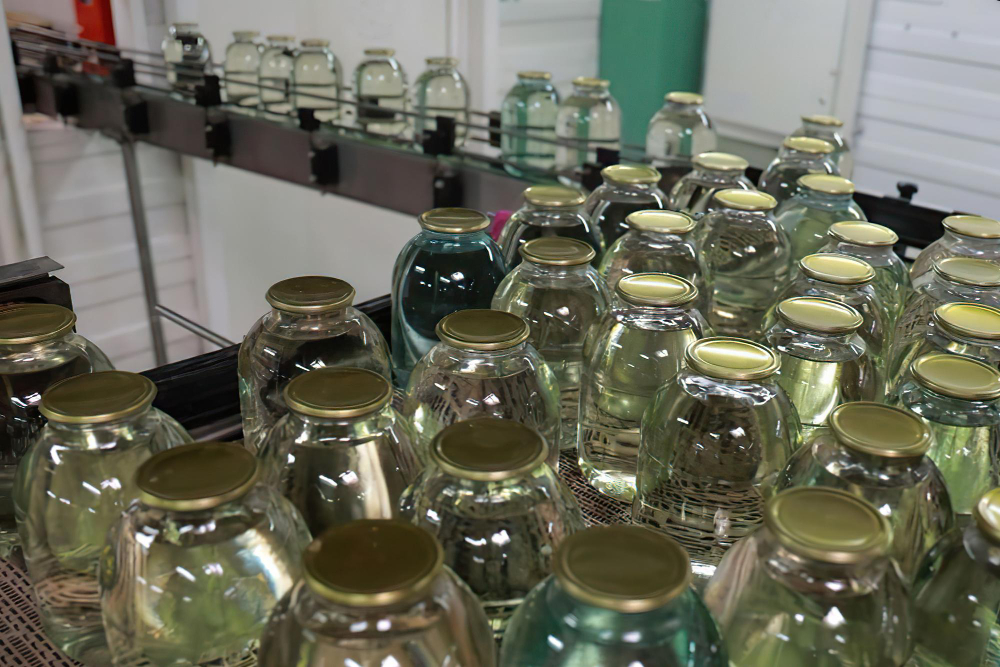
Case packing jars means grouping fragile, heavy units into transport-ready cases without impacts between containers. Only jars that passed every previous check should reach this stage.
Wrap-around case packing for jars
Our case packing systems include intermittent and continuous wrap-around case packers, which form the case around the grouped product. We match the machine to the jar format, the case pattern and the line speed.
Glass and plastic jars behave differently here. Glass jars need controlled grouping to avoid contact between containers, while light plastic jars need guidance, so they do not tip over before the case is formed. Both factors are part of the case packer specification from the start.
Checking packed cases with Visiobox
Before the pallet, Visiobox inspects the packed case: box condition, labels, codes and the presence or absence of jars inside. A missing jar detected here is far easier to correct than a short case found at the customer’s warehouse.
Palletizing jars with robotic palletizers
Palletizing jars is the last automated step, and it reduces manual handling of heavy cases at the end of the line. Our palletizing robots cover different throughputs: the R200 handles up to 20 boxes per minute, the R350 up to 35 and the R700 up to 70 cases per minute with Easy Layer.
The robots adapt to the box type, include a layout editor for pallet patterns and can integrate machine vision. Coordinating them with case packing keeps a continuous flow from the filler to the stretch wrapper.
How jar inspection systems support FDA food packaging compliance
FDA food packaging compliance is the manufacturer’s responsibility, and no machine certifies it on its own. What jar inspection systems provide is consistent control and data that the Quality team can use within its own food safety program.
Under the FSMA Preventive Controls for Human Food rule, covered food facilities must have a food safety plan, and corrective actions and verification activities must be documented. The requirements are set out in 21 CFR Part 117. Many jarred sauces, pickles and vegetables also fall under the FDA rules for acidified foods and for thermally processed low-acid foods in hermetically sealed containers, 21 CFR 113 and 114, which include registration and process filing with the FDA.
In that context, 100% real-time inspection of caps, vacuum, fill level and codes, together with inspection reports and rejection records, gives the plant objective data on each closure and each lot. Which controls your food safety plan needs is defined by your own hazard analysis.
From empty jar to pallet with E2M COUTH
At E2M COUTH, we approach jar inspection systems as one sequence, in which each stage prepares the next: Ebivision for empty jars, Flexiturn for orientation, Visiolevel or InspectLevel RF for fill level, Visiocap, Contourcap and Inspectvacuum for the closure, Contourvision and Verifytext for labels and codes, Multistep, Proportional Rejection or Push Rejection for non-conforming units, wrap-around case packing with Visiobox, and R-series robots for palletizing.
Connecting these systems on the same line reduces the cost of poor quality, improves OEE and keeps 100% inspection running at production speed. If you are planning jar inspection systems, rejection or end-of-line automation for your facility, contact us to discuss your application and identify the E2M COUTH solutions that fit your production requirements.