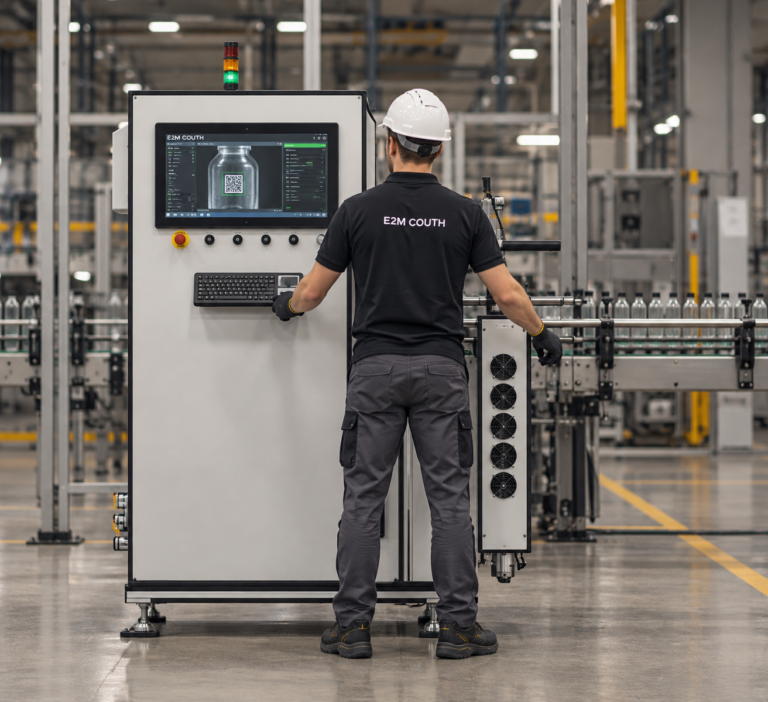
At E2M COUTH, we know that foreign body detection in food is not only a quality checkpoint; it is a direct safeguard for consumers, brands, and production efficiency. In canned food lines, a small fragment, residue, or visible contaminant can compromise safety, force product rejection, and create avoidable waste. That is why we develop inspection systems designed to detect external elements at the right stage of the process, before they become a bigger problem.
With solutions such as Contamination DL, we help manufacturers distinguish between normal product variations and real contamination risks, improving foreign body control in food while reducing unnecessary rejections, protecting raw materials, and supporting more sustainable production from the very beginning.
Why foreign body detection in food is essential for manufacturers
Foreign body detection in food is a critical part of modern production because it protects the consumer, the manufacturer, and the integrity of the entire supply chain. In the food industry, even a small external element can create serious consequences: a rejected batch, a product recall, a damaged brand reputation, or a loss of confidence from retailers and final consumers.
At E2M COUTH, we understand that manufacturers need more than a final quality check. They need reliable inspection systems that help prevent contamination risks before the product advances through the line. This is especially important in canned food production, where the container, the product, and the filling process must work together under strict safety and hygiene standards.
Foreign bodies can include fragments of plastic, cardboard, metal, packaging residues, particles, or any visible element that does not belong in the product. Detecting them early allows manufacturers to act quickly, isolate the problem, and avoid sending compromised units further into production.
However, effective foreign body control in food is not only about finding defects. It is also about doing so with precision. Natural product variations must not be confused with dangerous external elements. When inspection is accurate, manufacturers can maintain high safety standards while reducing unnecessary waste, avoiding false rejections, and improving the profitability and sustainability of their production process.
What can go wrong when foreign body control in food is not precise?
When foreign body control in food is not precise, the consequences can affect every part of the production chain. A contaminated product that reaches the market can lead to complaints, withdrawals, recalls, and serious damage to consumer trust. For food manufacturers, these situations are not only costly; they can also weaken long-term relationships with retailers and distributors.
But lack of precision can also create another problem: rejecting products that are actually safe. In many food lines, especially when working with natural products, irregular shapes, color variations, marks, or texture differences may appear during normal production. If the inspection system cannot distinguish these natural characteristics from a dangerous external element, the line may generate unnecessary false positives.
False positives increase waste. They can lead to the rejection of acceptable products, the loss of raw materials, additional disposal costs, and avoidable interruptions in production. Over time, this reduces efficiency and makes the process less sustainable.
At E2M COUTH, we believe accurate inspection must do two things at the same time: detect real risks and avoid unnecessary rejections. That balance is key to protecting food safety without wasting products that meet quality standards. Precision, therefore, becomes a strategic factor for profitability, sustainability, and reliable quality control.
How the Contamination DL system improves the inspection of canned food
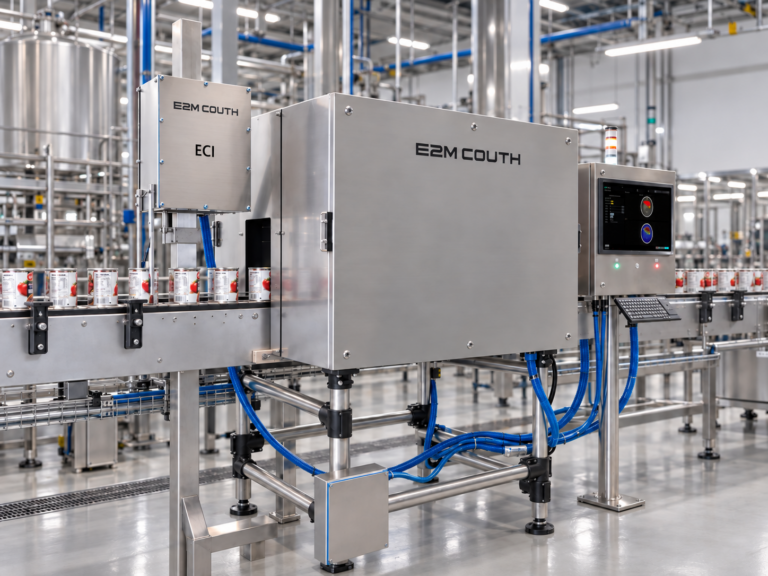
The Contamination DL system is designed to help manufacturers inspect the product inside the container with a high level of accuracy. In canned food production, this is essential because contamination risks are not always linked to the container itself. Sometimes, the problem appears in the product content: a visible foreign body, a residue, or an external element that should not be there.
At E2M COUTH, we developed Contamination DL to identify defects and contaminants in filled tins, helping production teams make faster and more reliable decisions. The system analyses each unit to detect elements that are not inherent to the raw material, such as plastic, cardboard, particles, or other visible foreign materials. This makes it a key solution for improving foreign body detection in food without slowing down the production line.
One of its main advantages is its ability to support precise classification. In many food products, natural irregularities are common. A product may have different shapes, tones, textures, or surface marks that do not represent a safety risk. Contamination DL helps distinguish these acceptable variations from dangerous external elements, reducing false positives and preventing the unnecessary rejection of good products.
This has a direct impact on efficiency and sustainability. When acceptable units are not discarded by mistake, manufacturers reduce raw material waste, avoid unnecessary disposal costs, and improve overall line performance. At the same time, real contamination risks can be detected before they advance further in the process.
For manufacturers, Contamination DL is not only an inspection system. It is a tool for safer production, smarter quality control, and more responsible use of resources.
How VisioInspect 2.0 distinguishes product irregularities from dangerous elements
In food production, not every irregularity is a contamination risk. Natural products can vary in shape, color, texture, and appearance, especially when they are processed, cut, cooked, or packed. The challenge is knowing when a visual difference is part of the product itself and when it indicates the presence of a foreign body.
At E2M COUTH, this is one of the key strengths of the Contamination DL system. Through VisioInspect 2.0, our inspection software, the system can analyze the product according to defined parameters and inspection criteria. This allows it to identify visible contaminants while reducing the risk of rejecting units that are actually correct.
This distinction is essential for efficient foreign body control in food. For example, a natural mark, an uneven surface, or a difference in product tone may be acceptable depending on the product type. However, a piece of plastic, cardboard, residue, or any external particle must be detected and rejected. VisioInspect 2.0 helps separate these two situations with greater consistency.
The result is a more reliable inspection process. Manufacturers can detect real risks while drastically reducing false positives, which are one of the main causes of unnecessary waste in food production. Fewer false positives mean fewer rejected good units, less raw material loss, and better use of packaging and production resources.
For us, classification is just as important as detection. It is not enough to find something different; the system must help determine whether that difference represents a real danger. That is how Contamination DL supports safer, more efficient, and more sustainable food production.
Early detection at the Empty Container Inspection Stage: Less waste, fewer losses
Early detection is one of the most effective ways to reduce waste in food production. When a problem is identified before the container is filled, manufacturers can prevent the loss of product, raw materials, energy, and production time. This is why the empty container inspection stage is so important within a complete quality control strategy.
At E2M COUTH, we understand that every container must be verified before it receives the product. A can with residues, particles, deformation, or visible defects can compromise the safety and quality of the final unit. If that container is not rejected early, the manufacturer may end up losing not only the packaging, but also the food inside it.
This has a direct impact on sustainability. Rejecting an unsuitable empty container is much more efficient than rejecting a filled one. It helps avoid unnecessary product loss, reduces disposal costs, and prevents valuable raw materials from being wasted due to a defect that could have been detected earlier.
Our empty container inspection solutions support this preventive approach by helping manufacturers identify possible risks before the filling process begins. Combined with Contamination DL, this creates a stronger inspection strategy: first, the container is checked; then, the product content is inspected.
The result is a safer, cleaner, and more efficient process. By detecting problems at the earliest possible stage, we help food manufacturers protect quality while reducing losses and making better use of their resources.
The role of Ebivision in empty container inspection
A complete foreign body detection strategy should not focus only on the product after filling. It should also begin with the container itself. This is where Ebivision plays an important role within the inspection process, helping manufacturers verify empty containers before they move forward on the production line.
At E2M COUTH, we designed Ebivision to support exhaustive empty container inspection and help ensure that each unit meets the required quality standards before filling. The system can detect residues, particles, visible defects, and foreign bodies that could compromise the final product if they are not identified in time.
This preventive approach is especially valuable in food and beverage production, where cleanliness, container integrity, and process reliability are essential. By inspecting the empty container before the product is added, manufacturers can avoid filling unsuitable units and reduce the risk of wasting raw materials.
While EbiVision helps verify the condition of the empty container, Contamination DL inspects the product content inside the tin. Together, both systems strengthen foreign body control in food and help create a safer, more efficient, and more sustainable production process.
Sustainability benefits of accurate foreign body detection
Accurate foreign body detection in food has a direct impact on sustainability because it helps manufacturers reject only what truly needs to be rejected. In many production lines, unnecessary waste does not come from real contamination, but from inspection systems that cannot correctly distinguish between a safe product irregularity and a dangerous external element.
At E2M COUTH, we focus on reducing that margin of error. When Contamination DL identifies real contaminants while limiting false positives, manufacturers can achieve several sustainability benefits:
- Less raw material waste, because acceptable products are not discarded unnecessarily.
- Fewer disposal costs, as the number of rejected good units is reduced.
- Better use of packaging, energy, and production resources.
- Fewer unnecessary line interruptions caused by incorrect rejections.
- A more stable and efficient production flow.
- Stronger food safety standards without increasing avoidable waste.
For manufacturers, sustainability is not only about reducing environmental impact; it is also about making smarter decisions at every stage of production. By combining safety, accuracy, and resource efficiency, we help food companies build more responsible inspection processes.
What to look for in a foreign body detection system for food lines
Choosing the right foreign body detection system in food production is essential to maintain safety, efficiency, and profitability. Manufacturers need solutions that can detect real risks without generating unnecessary waste or slowing down the production line.
At E2M COUTH, we believe an effective inspection system should offer:
- High-speed inspection capacity for demanding food production environments.
- Accurate detection of visible foreign bodies and contaminants.
- Low false rejection rates to avoid wasting acceptable products.
- The ability to distinguish natural product irregularities from dangerous external elements.
- Easy configuration of correct and incorrect product parameters.
- Fast format changeover to adapt to different products or containers.
- Real-time production statistics for better process control.
- Integration with existing production lines and conveyors.
- Connectivity with MES or ERP systems to improve traceability.
- Remote diagnostics to support maintenance and reduce downtime.
- User-level software configuration for greater operational flexibility.
A good system should not only detect contamination. It should also help manufacturers make smarter decisions, protect product quality, reduce waste, and strengthen foreign body control in food across the entire production process.
Why choose E2M COUTH for foreign body control in food?
At E2M COUTH, we develop inspection solutions for real food production environments, especially canned goods and container inspection lines. We combine empty container inspection with product content inspection to help manufacturers improve quality, safety, efficiency, and sustainability. Our systems are designed to detect real risks while reducing avoidable waste through precise classification of product irregularities and foreign elements.
To find the most suitable inspection configuration for your production line, contact us and let us assess your needs.