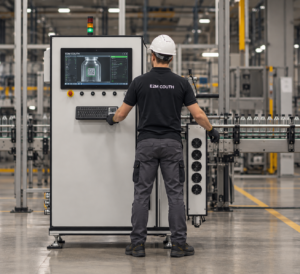
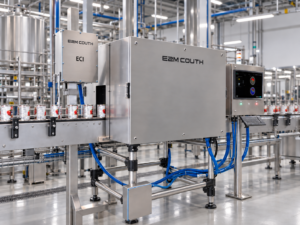
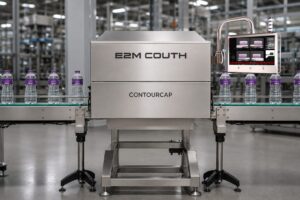
In today’s industrial landscape, efficiency and quality are not just goals, they are fundamental requirements for competing globally. The industrial vision systems developed by E2M COUTH provide manufacturers, distributors, and suppliers with a decisive advantage: the ability to automate inspection, guarantee compliance, and optimize every stage of the production process.
Far from being a simple control tool, an industrial machine vision system becomes a strategic investment that increases reliability, reduces costs, and enhances sustainability. Below, we explore the main advantages in detail.
Reliability: Consistency in every product
Reliability is one of the cornerstones of any automatic inspection machine. By analyzing every unit with precision, these systems ensure that products consistently meet the correct specifications. This means that no defective or poorly labeled product reaches the market, protecting both your customers and your brand. In industries such as pharmaceuticals, food, and automotive, where safety and accuracy are non-negotiable, reliability is more than a benefit, it is a necessity. A consistent inspection process also reduces the likelihood of costly recalls and strengthens consumer trust, which is essential in today’s highly competitive environment.
Adaptability: Tailored to Each Industry
Not all industries have the same needs, which is why our industrial vision systems are designed with adaptability in mind. You can configure them to check parameters such as size, weight, shape, color, surface finishes, or packaging integrity.
For example, in the food industry, these systems can detect whether a package is properly sealed or whether a label is positioned correctly. In the electronics sector, they can identify defective wiring or missing components. This flexibility allows a single industrial inspection machine to perform multiple roles, making it a cost-effective and scalable solution.
Speed: Inspection Without Interruptions
In industrial production, time is money. Traditional manual inspections are slow and prone to error, which limits efficiency and increases costs. With our industrial machine vision systems, inspections occur in real time and at the same speed as your production line.
Even at high volumes, these machines are capable of detecting defects within milliseconds, ensuring that no delay compromises output. The result is higher productivity without sacrificing accuracy. For companies working with tight deadlines or mass production, speed is not just an advantage, it is the key to maintaining competitiveness.
Flexibility: Easy Integration and Operation
Another great advantage of the vision systems for industry from E2M COUTH is their flexibility. These devices can be installed at different points of the production line depending on the needs of each company. Whether integrated into packaging, labeling, or final product control, they adapt to the unique characteristics of your process.
In addition, their intuitive software and auxiliary calculation systems reduce the need for specialized training. Employees can easily manage the systems without having to become experts in machine vision. This simplicity translates into faster adoption, reduced operational costs, and a shorter learning curve.
Safety: Preventing Risk and Protecting Customers
Safety is a top priority in sectors such as healthcare, automotive, and food production. A product with a defect or incorrect labeling can put consumers at risk and expose companies to lawsuits or regulatory penalties.
With an industrial inspection machine, potential problems are detected instantly, before the product leaves the plant. This ensures that only items meeting strict safety and quality standards reach the customer. By preventing defective products from circulating, companies also avoid damage to their reputation and costly product recalls.
Sustainability: Reducing Waste and Saving Resources
Sustainability has become a crucial factor in modern industry, not only for environmental reasons but also for economic ones. Our industrial vision systems help companies reduce waste by identifying defects early in the production process. This means fewer products need to be discarded, saving raw materials and lowering energy consumption.
Additionally, the data collected by these systems can be used to identify recurring errors and prevent them in future production runs. This continuous improvement cycle reduces resource usage and contributes to greener, more sustainable operations. Ultimately, sustainability through industrial machine vision is both a financial and environmental benefit.
Data-Driven Decision Making: Turning Inspection Into Strategy
Beyond inspection, automatic inspection machines generate a wealth of data. Each analysis performed is stored and processed, creating detailed reports on product quality, error frequency, and production efficiency. This information provides managers with actionable insights to improve processes, reduce downtime, and optimize resource allocation.
For example, recurring defects in a specific production batch may indicate a mechanical issue that needs preventive maintenance. By transforming data into strategy, companies can move from reactive correction to proactive improvement, creating smarter and more competitive production environments.
Competitive Differentiation: Standing Out in the Market
Implementing industrial vision systems is not only about meeting quality standards, but also about gaining an advantage over competitors. Customers and partners are more likely to trust companies that can demonstrate rigorous quality control and reliable traceability.
In global markets, where competition is fierce and regulations are strict, having an industrial machine vision solution is often the difference between securing a contract or losing it. By adopting this technology, companies signal innovation, responsibility, and commitment to excellence.