In production lines for beverages, food, pharmaceuticals, cosmetics, or chemicals, the quality of the finished product begins long before the container is filled.
A deformed plastic bottle, an incorrect fill level, a misaligned cap, an illegible code, or an error during case packing can compromise product compliance and result in financial losses.
The later an issue is detected, the greater its impact on resources, production efficiency, and quality-related costs.
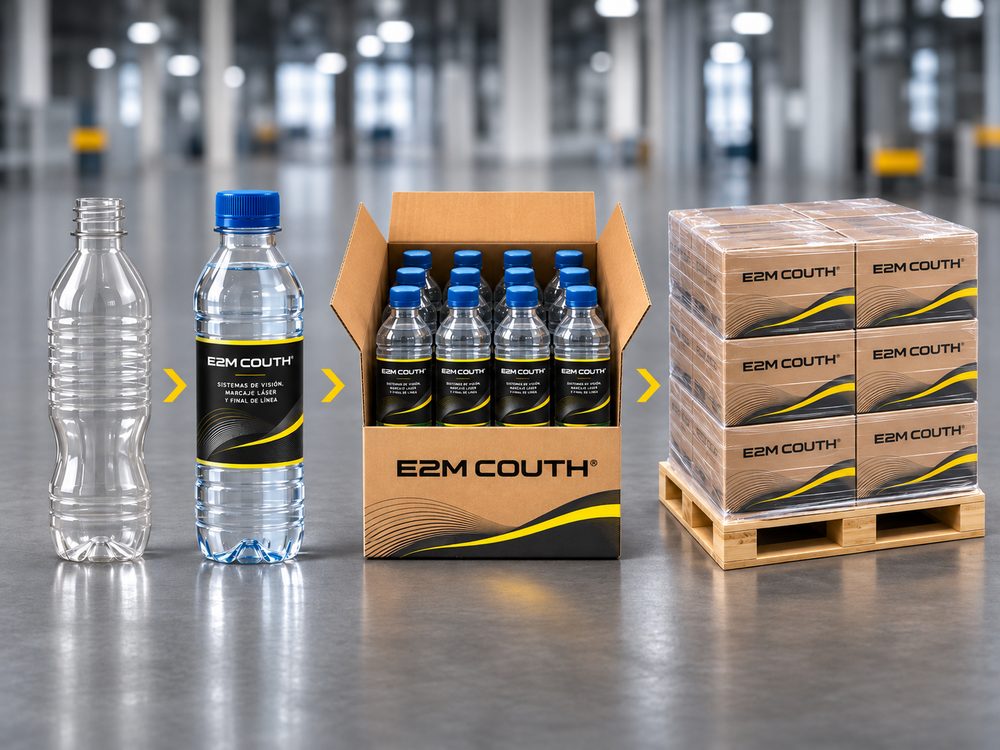
At E2M COUTH, we develop solutions for machine vision inspection, laser marking, and end-of-line automation, designed to control quality at the various stages of production, from the empty container to the finished and palletized product.
Why is it important to control quality at every stage of a production line?
Non-quality costs are those resulting from products or processes that do not meet established requirements. On a packaging line, these can manifest as waste of raw materials, rejected products, rework, production downtime, returns, or customer complaints.
Detecting a defect in a container before it is filled helps prevent unnecessary product consumption and the resources associated with subsequent operations.
However, if that same defect is identified after labeling, marking, boxing, or palletizing, the cost associated with the issue can be considerably higher.
For this reason, quality control must be approached holistically, incorporating inspection and automation systems at those points along the line where they add the most value.
1. Inspection of Empty Plastic Containers: The First Quality Control Step
Plastic containers, such as PET, HDPE (high-density polyethylene), or PP bottles, may exhibit irregularities resulting from their manufacture, handling, or transport.
Before beginning the filling process, it is important to verify that the container meets the acceptance criteria defined for the application.
Machine vision inspection systems allow for various checks, depending on the container’s characteristics:
- Detection of visible deformations and irregularities.
- Inspection of the container’s geometry.
- Presence of foreign objects or visible debris.
- Inspection of specific critical areas, such as the mouth or neck of the container.
The transparency, color, geometry, and surface finish of the plastic determine the configuration of the inspection system; therefore, each application requires a specific analysis.
Detecting and removing non-conforming containers before filling prevents resources from being allocated to a product that would later have to be rejected.
2. Container Orientation: Preparing the Product for Subsequent Operations
The diversity of formats, geometries, and designs of plastic containers makes orientation a particularly important step on certain production lines.
Orientation systems automatically position containers prior to operations such as filling, capping, labeling, or case packing.
Incorrect orientation can lead to positioning errors, issues during labeling, or interruptions in certain operations.
At E2M COUTH, we develop orientation systems tailored to different container formats and production needs, ensuring process continuity and reducing issues associated with incorrect positioning.
3. Inspection of filled containers: level, cap, and label checks
Once filling is complete, quality control faces new demands. The container now holds product and has gained greater value within the production process.
At this stage, inspection systems allow for the verification of various characteristics of the finished product.
Fill Level Inspection
An incorrect fill level can result in financial losses due to both overfilling and underfilling.
Overfilling results in additional product consumption, while underfilling can lead to product rejection, failure to meet established specifications, or customer complaints.
Solutions such as VisioLevel and InspectLevel RF enable control of the fill level using various technologies, selected based on the characteristics of the container and the product, including applications with opaque or translucent containers.
Cap and Closure Inspection
Proper cap placement is essential for preserving product integrity during handling, storage, and distribution.
Using systems such as VisioCap and ContourCap, it is possible to perform checks related to:
- Presence or absence of the cap.
- Position and tilt.
- Proper closure placement.
- Certain visible defects associated with capping.
These inspections are particularly important on beverage lines using PET bottles and integrated caps, as well as on packaging for cosmetic, pharmaceutical, or chemical products.
Label Inspection
The label serves both an informational and a commercial purpose. An incorrect, damaged, or misaligned label can compromise product identification and its presentation to the consumer.
The VisioLabel and ContourVision 360º systems address various labeling inspection needs, including the detection of defects, positioning errors, or missing labels, depending on the system configuration.
Automating these checks allows for the detection of deviations during production, before the containers proceed to the end of the line.
4. Machine Vision and Artificial Intelligence: Tailoring Inspection to Each Application
Not all defects present on plastic packaging can be detected using the same inspection method.
While certain checks can be performed using predefined parameters and criteria, others exhibit greater variability due to the packaging’s geometry, reflections, material characteristics, or the nature of the defect.
At E2M COUTH, we have developed VisioInspect 2.0, our proprietary industrial inspection software, which integrates machine vision, artificial intelligence, and data management into a single platform.
The combination of these two technologies allows inspection methods to be tailored to the needs of each application, addresses defects of varying complexity, and analyzes the results obtained during the process.
This information facilitates the identification of recurring deviations and provides relevant data for the continuous improvement of production.
5. Laser Marking and Verification: Traceability of Plastic Packaging
The correct identification of packaging is another key aspect of a production line.
Lot numbers, expiration dates, DataMatrix codes, QR codes, and other references allow the product to be linked to relevant information for tracking purposes.
Laser marking on plastic packaging allows this information to be applied directly to compatible materials, without the need for ink.
At E2M COUTH, we offer fiber, MOPA, and CO₂ laser marking solutions; the choice depends on the type of plastic, the required contrast, the code’s characteristics, and production conditions.
Through in-motion marking solutions, such as Mark on the Fly (MOTF), it is possible to integrate this operation into lines where containers move continuously.
Marking Alone Is Not Enough: The Importance of Verification
A code may be present on the container and yet still be illegible, incomplete, or contain incorrect information.
Therefore, inspecting the marking using machine vision ensures that the generated information meets the criteria defined for the application.
With Mark, Verify, and Trace, we integrate the following into a single process:
- Laser marking of the information.
- Automatic verification of the marking using machine vision.
- Recording of inspection results.
The integration of these processes facilitates the detection of coding errors and helps maintain product traceability throughout the line.
6. Automatic Rejection: Taking Action on Non-Conforming Products
Detecting a defect is essential, but so is preventing non-conforming products from continuing down the line.
Automatic rejection systems receive information from inspection equipment and enable the removal of packages that do not meet established quality criteria.
For plastic packages, factors such as weight, stability, geometry, content, and production speed determine the selection of the rejection system.
Proper coordination between inspection and rejection helps to:
- Remove nonconforming units at the appropriate point in the process.
- Minimize false rejections.
- Prevent unnecessary damage to other containers.
- Maintain production continuity.
The goal is not to reject more product, but to detect and remove only those units that do not meet the defined quality requirements.
7. End-of-Line Automation: From Individual Containers to Packaged Products
Once the necessary inspections have been performed, the product must be prepared for subsequent storage and distribution.
End-of-line automation enables the organization, grouping, and packaging of plastic containers through coordinated processes tailored to the needs of each facility.
Forming, Case Packing, and Case Sealing
Handling plastic containers requires taking into account factors such as their stability, pressure resistance, dimensions, and grouping format.
Depending on the application’s characteristics, the end-of-line process may incorporate:
- Case formers: automatic preparation of cases to receive the product.
- Case packers: grouping, positioning, and placing the containers into the corresponding packaging.
- Case sealers: automated sealing of the packaging to facilitate handling and distribution.
Case packing solutions can be adapted to different formats, such as plastic cases, RSC cardboard boxes, or wrap-around systems, depending on production needs.
Automating these operations helps reduce handling errors, improve packaging consistency, and minimize issues during logistics phases.
Box and Group Inspection
Quality control does not end with the individual inspection of containers.
A box may contain compliant products and still have errors in the number of units, their arrangement, or the composition of the set.
Using VisioBox, it is possible to perform various inspections on the boxes and their contents, such as checking for the presence or absence of packages, verifying heights, or detecting specific format errors.
This inspection allows for the detection of issues before the packaging is permanently sealed or before it is placed on the pallet, depending on where the system is installed.
8. Automatic Palletizing: The Final Stage of the Production Process
Palletizing is one of the final operations before the finished product is stored and distributed.
Incorrect arrangement of boxes or groups can compromise the stability of the load, cause damage to the product, and lead to incidents during transport.
Automatic palletizing systems allow products to be organized according to predefined patterns, taking into account the dimensions, weight, and characteristics of the groups.
At E2M COUTH, we develop palletizing solutions, such as the R200 Palletizing Robot, designed to automate this stage and adapt the pallet configuration to the process’s needs.
Automating palletizing helps improve the repeatability of operations, reduce manual handling, and facilitate the transition between production and logistics.
What should be considered when automating a plastic packaging line?
Not all production lines require the same systems or have the same inspection and automation needs.
To define a solution tailored to the process, it is necessary to analyze:
- Material, dimensions, and geometry of the packaging.
- Transparency, color, and surface finish.
- Characteristics of the packaged product.
- Types of defects and acceptance criteria.
- Production rate and format changes.
- Identification and traceability requirements.
- Grouping, case packing, and palletizing formats.
- Integration with existing machinery and management systems.
Jointly defining these factors allows us to select the most appropriate technologies and determine at which points along the line each solution adds the most value.
From Empty Containers to Palletized Products: A Comprehensive View of Quality
At E2M COUTH, we view quality control as a process that accompanies the product throughout the entire production line.
Our machine vision and artificial intelligence systems, laser marking, and end-of-line automation enable us to address various needs for inspection, identification, traceability, and product handling.
From the inspection of empty containers to the formation of the final pallet, each stage represents an opportunity to detect deviations, optimize resources, and reduce quality-related costs.
Do you want to improve quality control and the efficiency of your production line?
At E2M COUTH, we analyze the characteristics of your application to develop solutions tailored to your production, inspection, and automation needs.
Request a feasibility study for your application
Frequently Asked Questions About Quality Control in Plastic Packaging Lines
What systems does a plastic packaging production line need?
Depending on the application, a line may incorporate systems for inspecting empty containers, orientation, fill control, cap and label inspection, laser marking, code verification, automatic rejection, case packing, and palletizing.
How can quality-related costs be reduced on a packaging line?
Through early defect detection, automatic removal of non-conforming products, verification of marked information, and automation of handling and packaging operations.
Can plastic containers be marked using laser technology?
Yes. Laser marking allows for the identification of various types of compatible plastic containers. The appropriate technology must be selected based on the polymer, the required contrast, and the characteristics of the application.
How does artificial intelligence contribute to the inspection of plastic containers?
Artificial intelligence complements machine vision systems and expands the possibilities for detecting complex defects or those with high variability, which are difficult to identify using predefined criteria.
Why is it important to inspect boxes before palletizing?
Because it allows for the detection of grouping errors, missing containers, or certain irregularities before the boxes are placed on the pallet and move on to logistics operations.