On an automated production line, correctly identifying each package is essential for maintaining product traceability. DataMatrix codes, QR codes, barcodes, or alphanumeric references allow for the incorporation of information that can be used during the various stages of the production process.
However, marking alone does not guarantee that the code is correct or legible. Incomplete, misaligned, or poorly contrasted markings can make product identification difficult and lead to quality and traceability issues.
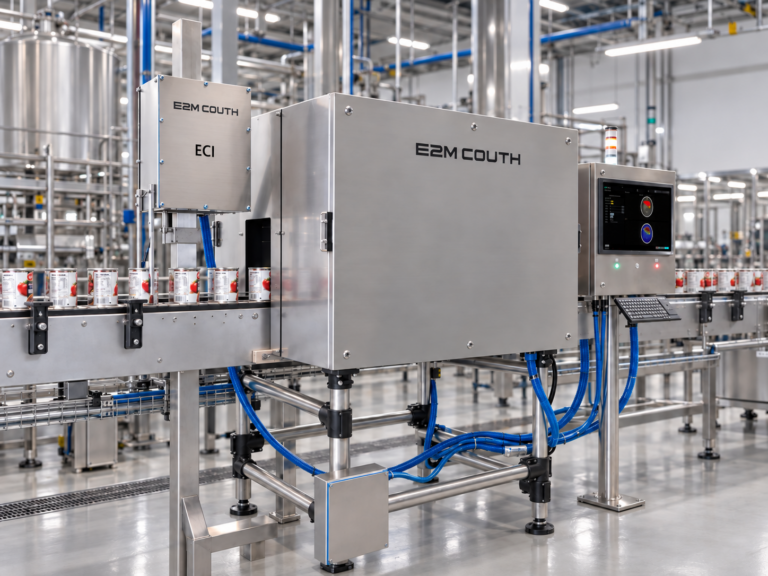
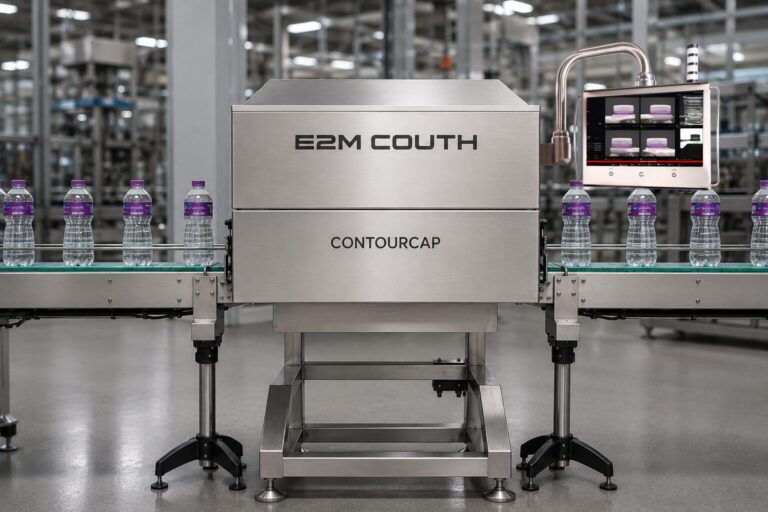
To address this need, E2M COUTH presents Mark, Verify and Trace, a solution that integrates laser marking of all types of codes, automatic verification using machine vision, and result logging into a single process.
The goal is to verify that each container has been identified in accordance with established criteria and to have information available on the verification results.
What is Mark, Verify and Trace?
Mark, Verify and Trace is an industrial solution that combines laser marking, traditional machine vision, artificial intelligence, and data logging to automate the identification and verification of packaging on production lines.
Its operation is structured in three phases: marking, verifying, and logging.
This integration allows the identification process to be handled in a coordinated manner, from code generation to verification and storage of the results.
MARK: Permanent Laser Marking
The first phase consists of generating the mark on the container’s surface using laser technology.
The system supports various types of information, such as DataMatrix codes, QR codes, barcodes, and alphanumeric characters, adapting to the identification requirements of each application.
Mark, Verify, and Trace can be configured with CO₂, fiber, or MOPA laser technology, depending on the material, the required contrast, and the production process conditions.
Contactless marking allows for the incorporation of permanent information on compatible materials without using marking tools that act directly on the surface.
VERIFY: Automatic Verification via Machine Vision
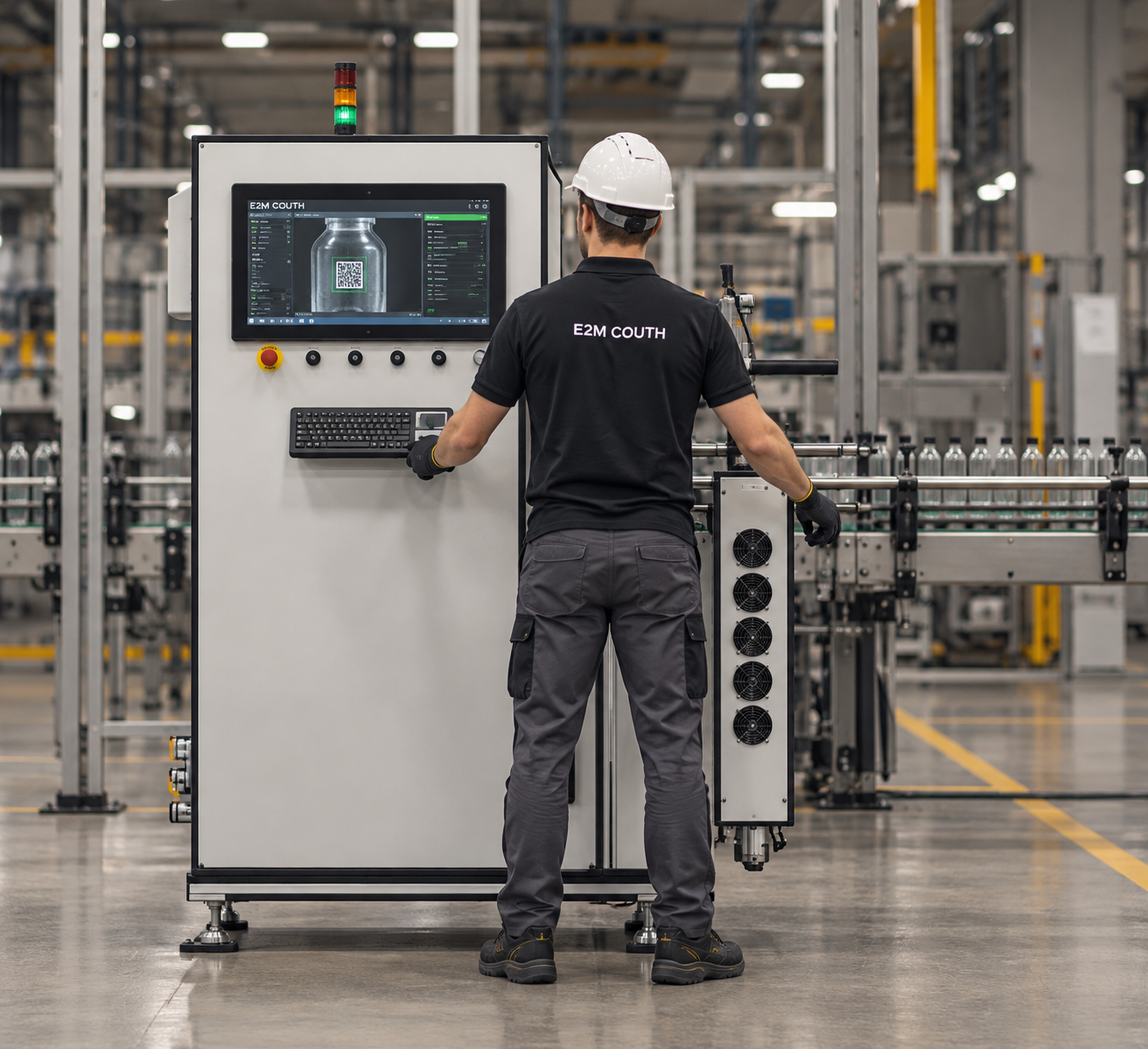
Once the marking is complete, the machine vision system captures an image of the code to verify that it meets the defined criteria.
By combining traditional machine vision with artificial intelligence, the system enables checks related to:
- The presence or absence of the marking.
- The legibility of the code.
- The position of the marking.
- The detection of incomplete or defective codes.
- Verification of the quality criteria established for the application.
This automatic verification allows for the identification of potential deviations during the production process, reducing reliance on manual visual inspections.
Additionally, it facilitates the integration of inspection results with other systems on the production line to manage units that do not meet the defined requirements.
TRACE: Recording Results for Traceability
The third phase consists of recording the results obtained during verification.
In this way, the system does not merely check the presence and legibility of the code but also allows for the retention of information regarding the outcome of the identification process.
This data can be used to review results, analyze incidents, identify trends, and facilitate monitoring and quality control tasks.
Mark, Verify and Trace offers communication capabilities with PLCs, production databases, and external systems via APIs, facilitating its integration into connected industrial environments.
The recorded information and its association with each unit will depend on the traceability configuration defined for the application.
What are the benefits of integrating marking and verification into a single system?
The integration of these three operations allows for addressing various production and quality needs.
Greater control over product identification
Automatic verification ensures that the marked code meets defined criteria, helping to detect errors before the product moves on to other stages of the process.
Reduction in non-quality costs
Detecting an incorrect or illegible code during production makes it easier to address the affected unit and reduces the risk of the problem being identified at later stages.
This can help reduce rework, incidents, and costs associated with incorrectly identified products.
Reduced reliance on manual verification
Automating marking verification allows for the application of repeatable inspection criteria and reduces manual intervention in control operations.
Information Available for Quality and Production
Recording results facilitates incident analysis and provides useful information for evaluating the performance of the marking process.
In this way, verification ceases to be merely a one-time check and becomes a source of data for production monitoring.
A solution configurable to the needs of each production line
Each application has different requirements related to packaging material, code type, production speed, or integration conditions.
Therefore, Mark, Verify and Trace allows you to select different laser technologies and configure the vision system based on process needs.
The solution includes a high-resolution camera, adjustable LED lighting, VisioInspect 2.0 software, and a 21-inch touchscreen monitor, as well as industrial communication options.
This combination allows for the adaptation of marking, verification, and results management to the identification and traceability requirements of each facility.
From Marking to Verified Traceability
Industrial identification does not end when a code is generated on the packaging.
For that information to be useful within the production process, it is necessary to verify that the marking has been performed correctly, that it is legible, and that the verification result is recorded.
Mark, Verify and Trace integrates these three operations into a single solution, linking laser code marking with quality control and industrial traceability.
Do you need to mark and verify the coding on your packaging?
At E2M COUTH, we analyze the characteristics of each application to define a solution tailored to the material, the type of code, and the production requirements.
Tell us what you need to mark and verify. Our team will analyze your application and help you determine the most appropriate configuration.