
At E2M COUTH, we offer innovative solutions to improve efficiency on production lines. We know that process optimization is essential to maximize profitability and maintain competitiveness in an increasingly demanding industrial environment. That’s why we’ve prepared this post to explain how to improve efficiency on a production line, addressing different strategies and technologies that can make a significant difference in productivity. Join us on this journey and discover how you can take your operations to the next level.
Why is it crucial to improve efficiency on a production line?
Improving efficiency on a production line is not just a matter of optimizing processes; it is about ensuring the long-term sustainability and profitability of production. In a competitive environment, companies that manage to improve productivity on their production lines are better positioned to reduce costs, increase their production capacity, and improve the quality of their products.
Reduced operating costs
Efficiency reduces downtime and material waste, which directly translates into lower operating costs. By eliminating inefficient processes, companies are able to maximize their resources and avoid unnecessary expenses, allowing each part of the production process to be aligned with business objectives.
Increased production capacity
An efficient production line allows more products to be processed in less time, increasing production capacity without the need for large investments in new facilities or equipment. This improvement in production capacity is very important for meeting increased market demand without sacrificing quality.
Improved product quality
Efficiency is not only measured by speed or reduced costs, but also by the quality of the final product. Improving each stage of production helps reduce errors and defects, leading to greater consistency in product quality. This is essential for maintaining customer satisfaction and brand reputation.
Competitive advantage
Companies that improve their efficiency also have the ability to react more quickly to changes in market demand and outperform their competitors in terms of costs, delivery times, and quality. This not only allows for better resource management, but also greater flexibility to adapt to market trends and customer needs.
Identifying production bottlenecks
Bottlenecks are critical points within the production line that limit the total capacity of the plant. Identifying and addressing them is one of the most important steps in improving efficiency on a production line. These bottlenecks can occur at different stages of production and affect workflow, causing delays, cost increases, and reductions in productivity.
What are bottlenecks?
A bottleneck refers to any part of the production process that limits the speed or capacity of the entire line. These can be caused by faulty equipment, a slow manual task, or even poor workflow distribution. When one of these points is saturated, production at other stages is slowed down, which slows down the entire process.
How to detect bottlenecks
There are several tools and methods for identifying bottlenecks within the production line:
- Workflow analysis: This involves analyzing how materials, products, and information move through the production line. If it is observed that at any stage the flow is considerably slower than at others, this is an indication that there could be a bottleneck.
- Real-time monitoring: Using technology such as IoT sensors or real-time monitoring systems, companies are able to track the performance of each piece of equipment and stage of the production process. This allows them to immediately detect any slowdown or accumulation of work at a specific stage.
- Reviewing cycle times: Analyzing cycle times at each part of the line is another effective way to detect bottlenecks. If the cycle time at one workstation is much longer than at others, this may be indicative of a bottleneck.
Common types of bottlenecks
Some common bottlenecks on production lines include:
- Inefficient or outdated equipment: Machinery that is not operating at full capacity can slow down the entire line. This can range from equipment that requires frequent maintenance to equipment that no longer meets production standards.
- Workload imbalance: If one workstation has a much higher workload than others, it can lead to a backlog of tasks, slowing down the overall process.
- Communication or coordination issues: Lack of coordination between production teams and distribution processes can lead to unnecessary delays. This is especially common in complex production lines with multiple work phases.
 Vision systems to avoid bottlenecks
How to eliminate bottlenecks
Once bottlenecks have been identified, it is important to take steps to resolve them and improve production flow. Some actions that can be taken include:
- Investment in technology and automation: Upgrading equipment and integrating automated solutions can help increase the speed and accuracy of certain stages of production. In many cases, automation helps reduce manual workloads, which are often critical points of delay.
- Redesign the workflow: Adjusting the distribution of tasks and the order of workstations can help balance the workload and prevent bottlenecks at specific points in production.
- Preventive maintenance: Implementing a proactive preventive maintenance program ensures that equipment runs smoothly, preventing mechanical failures from causing bottlenecks.
Process automation: an essential step toward efficiency
Process automation has become one of the most effective solutions for improving efficiency on a production line. Incorporating advanced technologies such as industrial robots, automated control systems, and intelligent software can significantly transform production operations, reducing times and increasing accuracy.
Advantages of automation
Automation eliminates human variation, contributing to more consistent and error-free production. By automating repetitive and physically demanding tasks, employees can focus on higher-value activities, such as process supervision or system optimization. This not only improves efficiency but also increases workplace safety by reducing exposure to risks.
Reduced downtime
Automated systems can operate continuously, significantly minimizing downtime compared to manual work. With the implementation of sensors and software, automation also facilitates predictive maintenance, ensuring that equipment remains operational and detecting potential failures before they occur.
Scalability and flexibility
Automated processes are scalable. This means that as demand grows, production capacity can also increase without the need for significant infrastructure expansion. In addition, automation allows processes to be quickly adjusted to accommodate changes in production or market requirements.
Implementation of advanced technologies with E2M COUTH solutions
At E2M COUTH, we know that implementing advanced technologies is very important for improving efficiency on a production line. That is why we offer solutions designed to optimize production processes through the efficient integration of technology and automation.
Process automation
Through our experience in industrial automation, we help companies implement advanced control systems that automate repetitive tasks and increase consistency in production. This not only reduces human error, but also increases production speed, which directly contributes to higher productivity on the production line.
Real-time control and monitoring systems
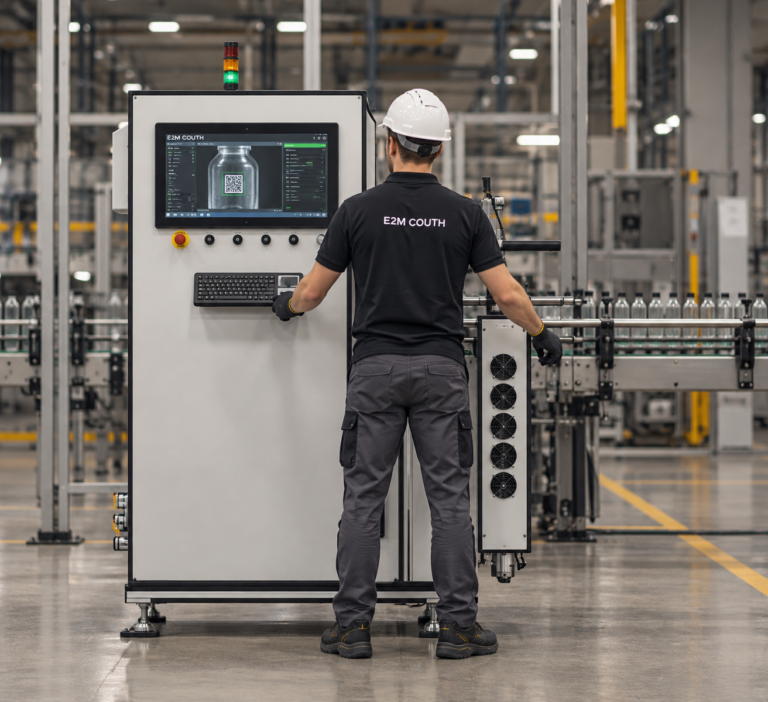
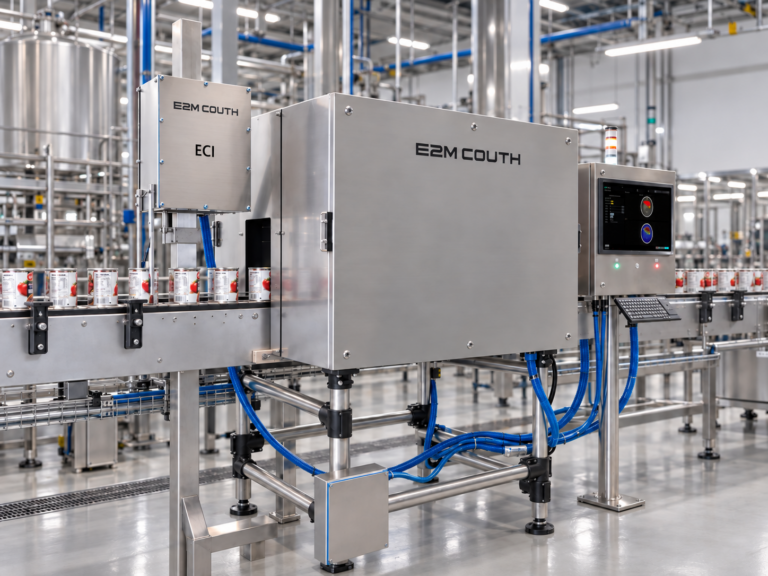
At E2M COUTH, we have advanced real-time monitoring and control systems, allowing production managers to constantly supervise the performance of machines and processes. This visibility allows us to identify potential inefficiencies or bottlenecks before they affect production, optimizing flow and reducing downtime.
Integration of machinery and customized software
We also offer customized solutions to integrate existing machinery with specialized software, improving communication between different parts of the production line and enabling quick real-time adjustments to maximize operational efficiency.
Continuous training and talent management
At E2M COUTH, we understand that improving efficiency on a production line depends not only on technology, but also on human talent. Continuous training is key to ensuring that employees are aware of best practices, new tools, and optimized processes.
Training in new technologies
The integration of new technologies, such as automated systems or management software, requires operators to be properly trained. E2M COUTH offers training programs to ensure that your team quickly adapts to innovations, thus maximizing the use of resources and improving productivity.
Promoting continuous improvement
In addition to technical training, we promote a culture of continuous improvement. This involves encouraging creativity, problem solving, and proactivity among employees. A well-trained and motivated team is better able to identify opportunities to improve production and optimize each phase of the process.
Optimization of human resources
Proper talent management is essential to get the most out of each team member’s abilities. E2M COUTH advises you on creating more efficient work teams, contributing to greater productivity and a more agile and effective work environment.
Preventive and proactive maintenance
Proper equipment maintenance is essential to improving efficiency on a production line. At E2M COUTH, we offer comprehensive solutions for implementing preventive and proactive maintenance programs that increase the useful life of assets and reduce downtime.
Preventive maintenance
Our focus on preventive maintenance ensures that machines are regularly checked and adjusted, preventing unexpected failures. This reduces the costs associated with urgent repairs and equipment replacement, while keeping production running smoothly.
Real-time monitoring
Through advanced monitoring systems, our systems can predict potential failures and take action before they affect operations. This foresight allows us to reduce unplanned downtime, which improves production line productivity and ensures greater operational efficiency.
Continuous optimization
Proactive maintenance also includes collecting data on machine performance, which allows us to identify patterns and areas for improvement. With this data, E2M COUTH helps adjust processes and maintain a more efficient and profitable production line in the long term.
 Customized solutions for your production lines
Improve your production line with E2M COUTH
Improving efficiency on a production line is a comprehensive process that ranges from process automation to ongoing employee training. Implementing advanced technological solutions, proactive maintenance, and constant performance evaluation are key to maximizing productivity and reducing operating costs.
By adopting these strategies, companies can transform their operations, optimizing each phase of production and ensuring continuous improvement. It is essential that every aspect of the production process is aligned with efficiency objectives in order to remain competitive in an ever-changing market.
If you want to optimize your production line and achieve maximum performance, E2M COUTH is here to offer you the most effective and customized solutions. Contact us to find out how we can help you take your production to the next level.