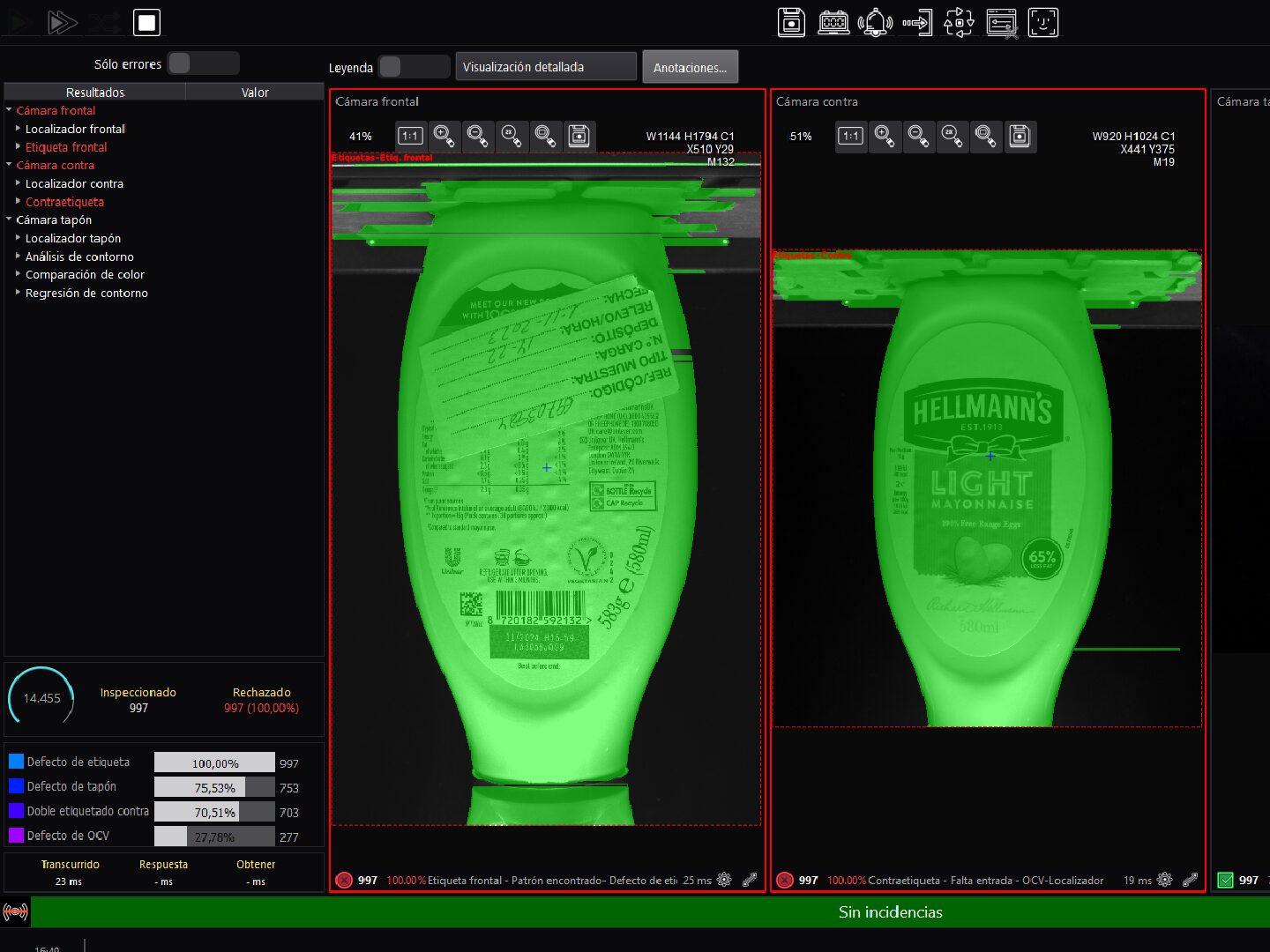
In increasingly demanding production environments, quality control no longer depends solely on inspection hardware. A system’s actual ability to detect, analyze, and manage deviations is directly linked to the software that controls it.
In this context, inspection software ceases to be a mere add-on and becomes the central element that defines the system’s precision, flexibility, and adaptability.
The Role of Software in Industrial Inspection
Machine vision systems have evolved significantly in recent years. However, their performance does not depend solely on cameras or lighting, but on how the information is processed.
Advanced inspection software enables:
- Analyzing large volumes of data in real time
- Adapting parameters according to the product or format
- Detecting complex deviations that are not visible with fixed rules
- Integrating with other systems in the production environment
Additionally, it incorporates key capabilities such as image segmentation, which allows for the precise identification and isolation of different parts of the product (labels, closures, geometries, critical areas), facilitating a more detailed and reliable analysis.
This makes the software a key element in ensuring process reliability.
From rule-based inspection to intelligent models
Traditional inspection systems are based on predefined rules. This approach works in controlled environments but has limitations when variations occur in the process.
The incorporation of technologies such as Artificial Intelligence and Deep Learning enables a shift toward more robust models capable of:
- Adapting to real-world production variations
- Detecting complex or unstructured defects
- Reduce reliance on manual adjustments
- Improve accuracy without increasing operational complexity
In this context, anomaly detection plays a significant role, enabling the identification of deviations from the product’s expected behavior, even when they do not correspond to previously defined defects. This is particularly useful in environments where variability is high or defects are non-recurring.
This change is particularly relevant on high-volume production lines, where variability is a constant factor.
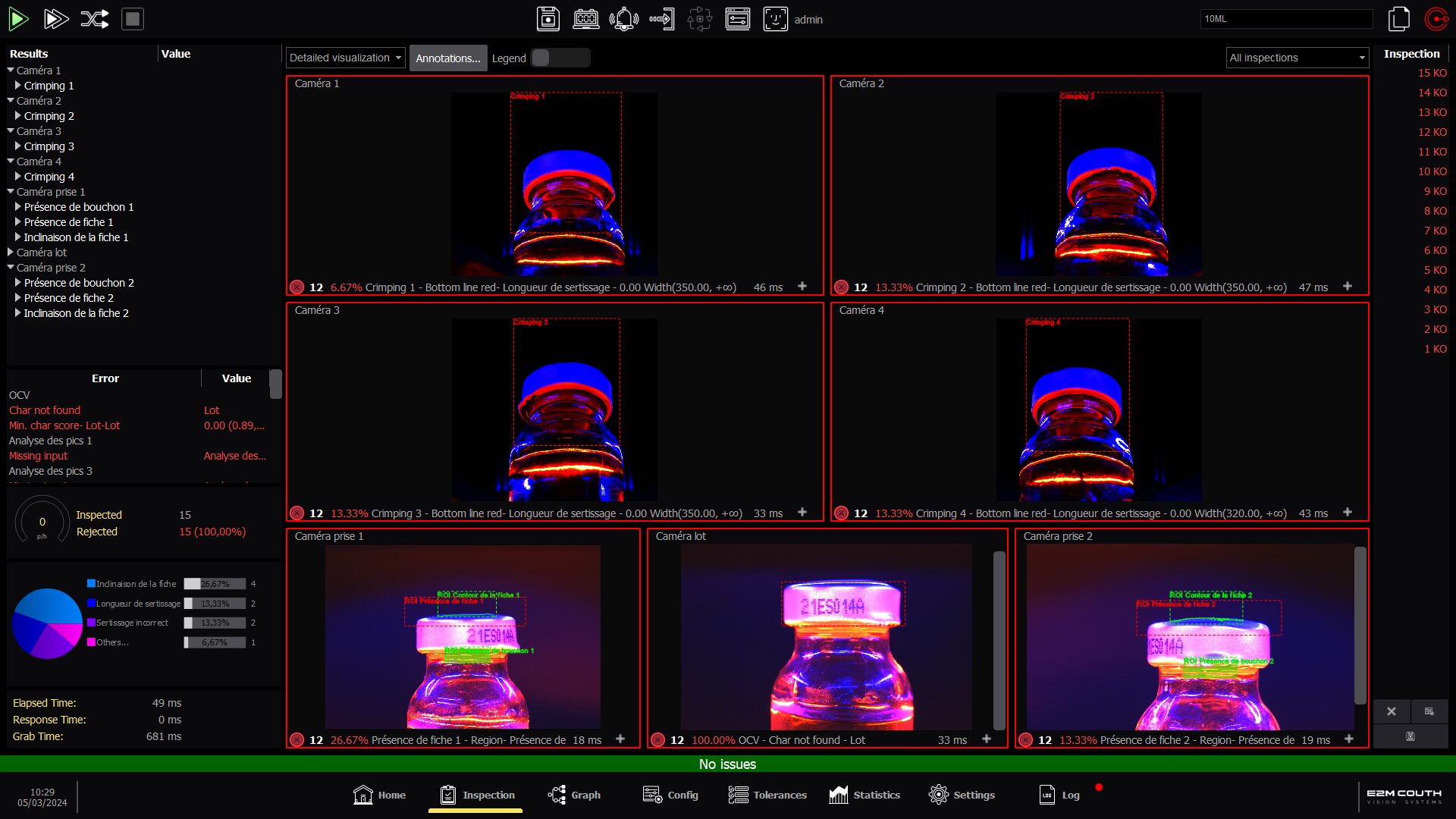
VISIOINSPECT 2.0: complete control of the inspection process
In this context, VISIOINSPECT 2.0 stands as the core of E2M COUTH’s inspection systems.
It is software developed entirely in-house, designed to offer complete control of the in-line inspection process, from image capture to analysis and results management.
Its architecture allows it to process 100% of production, detecting defects related to:
- Container shapes and geometries
- Labeling
- Sealing and product integrity
- Traceability elements such as OCR, OCV, Datamatrix, and other codes
Thanks to the combination of segmentation techniques and advanced analysis models, the system is capable of evaluating each element independently, improving accuracy and reducing false rejects.
Real-time data for decision-making
Beyond defect detection, the software provides visibility into process behavior.
The generation of real-time statistics allows for:
- Identifying error patterns
- Detecting recurring deviations
- Analyzing line performance
- Making data-driven decisions
In this way, inspection ceases to be a one-off check and becomes a tool for continuous improvement.
Integration into connected industrial environments
In the context of Industry 4.0, integration capability is key. VISIOINSPECT 2.0 is designed to:
- Integrate with MES and ERP systems
- Manage configurations remotely
- Adapt to different inspection technologies (2D, 3D, multispectral, etc.)
- Control system components such as rejectors or separators
This enables the creation of comprehensive, connected, and scalable solutions.
Beyond inspection: process control
The value of software like VISIOINSPECT 2.0 lies not only in detecting errors, but in its ability to control the production process. By analyzing 100% of production, reducing false rejects, and generating useful information, it enables:
- Improving process stability
- Reducing the cost of non-quality
- Increasing operational efficiency
- Ensuring product traceability
Inspection software has become a strategic element within industrial production.
Solutions like VISIOINSPECT 2.0 enable progress toward a more controlled production model, where quality does not depend on sporadic checks, but on a system capable of continuously analyzing, adapting, and improving.
If you are evaluating how to optimize inspection in your production process, the first step is to understand what level of control you need and how the software can help you achieve it.
At E2M COUTH, we develop solutions where software is key to tailoring inspection to each application, improving system reliability, and providing real-time visibility into the process.
If you’d like to analyze your specific situation, we can help you define the most appropriate inspection approach based on your quality, production, and traceability requirements.